
[News Space=Reporter seungwon lee] As North Korea begins to implement a science and technology-centered policy in earnest, analysis has emerged that the spread of digital technology is progressing rapidly, with universities utilizing generative artificial intelligence (AI) such as ChatGPT and one in four residents owning a mobile phone.
The "2025 Inter-Korean Broadcasting and Communications International Conference," hosted by the Korea Communications Commission, the Korea Information Society Development Institute, and Hanyang University's Unification Education Leading University Project Group at Hanyang University in Seoul on the 4th, highlighted North Korea's current state of digital transformation and future direction.
AI utilization in universities, healthcare, security, and other sectors is gaining momentum.
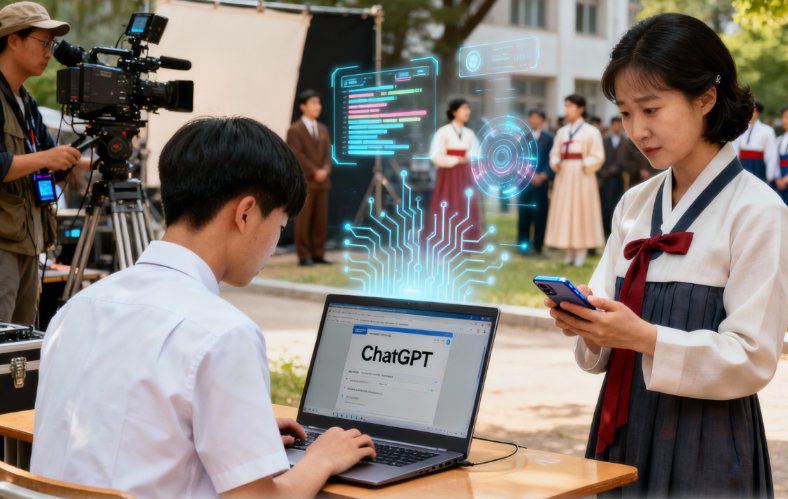
Park Min-joo, a professor at the Institute for Unification Education, said, "Since Kim Jong-un came to power, North Korea has been pursuing a policy of prioritizing science and technology in order to build an economic powerhouse through a scientific and technological revolution." She added, "Currently, North Korean universities are utilizing ChatGPT for research and education, and face matching technology and artificial intelligence robots for medical service support are also being introduced."
In particular, there are indications that North Korea's use of AI is expanding beyond simple education and research to military and cyber fields, such as training hackers and elite IT personnel.
Kim Min-jung, a research fellow at the Institute for National Security Strategy, analyzed that North Korea has been steadily conducting AI-based research in pattern recognition, voice processing, and data optimization since the late 1990s, and has recently expanded into high-difficulty areas such as facial recognition, multi-object tracking, and lightweight voice synthesis.
Mobile phone penetration rate expected to reach 27-29% by 2025
North Korea's mobile phone penetration rate is estimated at around 27-29% as of 2025. Martin Williams, a senior researcher at the Stimson Center in the United States, said, "It's estimated that there are 6.5-7 million mobile phone subscribers in North Korea, or one in four residents."
According to UN estimates, North Korea's population is estimated at 25.5 to 26.2 million. As of 2023-2024, the number of mobile phone connections is projected to reach 7.51 million, representing a 28.7% penetration rate. This represents a significant increase from the 6 million (24%) in 2019, and the penetration rate in major cities is reported to reach 70%.
Recently, the number of smartphone models sold has doubled, and new brands have emerged, accelerating technological diversification.
Digital upheaval ripples throughout North Korean society
The proliferation of digital technology in North Korea goes beyond simple changes in communication and information access, driving structural changes across society. The KDI North Korea Economic Review (May 2025) analyzed that the proliferation of mobile phones has contributed substantially to increased income for vulnerable groups and improved residents' access to information and the quality of communication.
Hanyang University's Unification Education Leading University Project Group announced that, based on discussions at this conference, it plans to continue exploring ways to cooperate in inter-Korean broadcasting and communications in line with the era of digital transformation.
The international community is on high alert regarding North Korea's AI and cyber capabilities.
North Korea's proliferation of AI and digital technologies is heightening international vigilance. The Institute for National Security Strategy (INSS) warns that North Korea is highly likely to use AI for cyber activities such as theft of crypto assets, money laundering, and the creation of false identities. The institute also assessed that cooperation among North Korea, China, and Russia is a key variable that could accelerate North Korea's application of AI for military and cybersecurity.
Accordingly, there are ongoing calls for the international community to closely monitor North Korea's AI technology diffusion and application, and to leverage this information to enforce sanctions against North Korea and manage supply chains.
In this way, North Korea is pursuing fundamental changes to its economic and social structure through science and technology and the digital revolution, and its residents' daily lives are rapidly being reorganized around mobile devices and AI. The pace and direction of North Korea's digital transformation will likely be a key focus for both the Korean Peninsula and the international community.